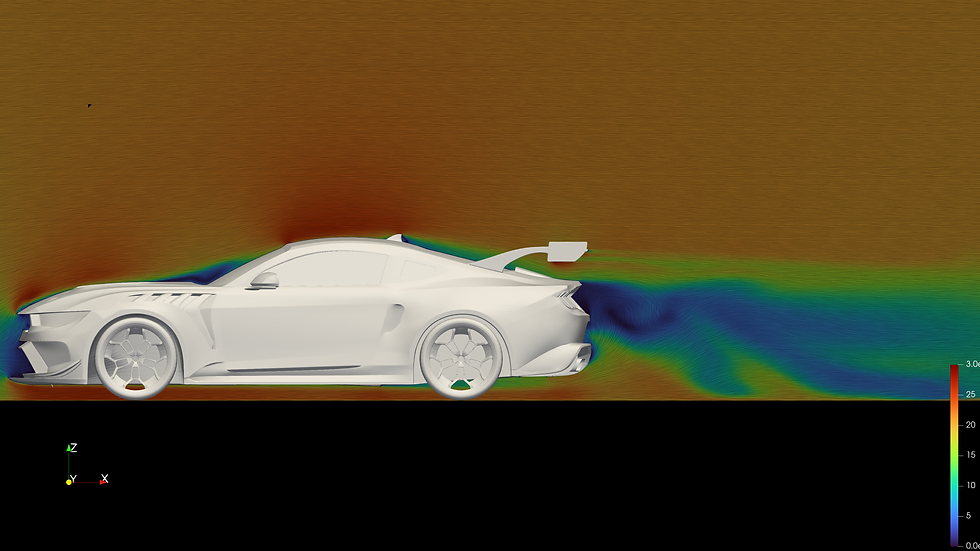
Ford Mustang GTD Active Aero Analysis - Collaboration with Povagowani
This project was created in collaboration with automotive YouTube creators Povagowani and focused on analyzing the active aerodynamic systems of the Ford Mustang GTD using detailed CFD airflow simulations.
The Mustang GTD is currently one of the fastest production cars ever tested on the Nürburgring, and this project aimed to understand how its aerodynamic systems contribute to that performance. Unlike traditional fixed-aero vehicles, the GTD constantly changes its aerodynamic configuration depending on driving conditions, balancing between maximum downforce and minimum drag.
The analysis examined key aerodynamic components including the front splitter, underbody, diffuser, rear wing, and active front flaps. Simulations showed that the front splitter maintained exceptionally clean airflow attachment, allowing the underbody to generate significant front downforce. Additional airflow management elements behind the front wheels helped redirect wheel turbulence away from the floor, improving overall aerodynamic efficiency.
Particular attention was given to the active rear wing and low-drag mode. In maximum downforce configuration, the rear wing generated extremely high aerodynamic load but also increased turbulence and drag. When low-drag mode was activated, the wing and front flaps adjusted their positions to reduce resistance and improve straight-line efficiency.
Simulation data revealed that activating low-drag mode reduced aerodynamic drag by approximately 23%, while downforce decreased by around 55%. The project demonstrated how the Mustang GTD uses adaptive aerodynamics to optimize both cornering grip and high-speed performance depending on track conditions.
https://youtu.be/QMAOc2NEJnI?si=LshEtU3R9rVwkGmj&t=964 <---- Povagowani